Invitation to Fall Shop Talk & Messabout in Portland, Maine


Please join me for the 2nd annual – “It’s a tradition now” – shop talk and messabout. This year we’ll welcome our guest designer/builder Walter Wales. Also with him will be WoodenBoat’s Associate Editor Karen Wales (Walter’s wife) and renowned illustrator Sam Manning and his wife Susan.

Walter is an acknowledged expert on the Marblehead Gunning Dory originally built by Will Chamberlain of Marblehead, Massachusetts. Sam illustrated John Gardner’s “Dory Book”

Walter and Karen will bring their Gunning Dory REPUBLICAN, built in 1960 by Capt Gerald Smith from Will Chamberlain’s molds.

Walter and Sam will talk about the history, design, construction, and use of this famous dory type. In addition to REPUBLICAN we’ll have a couple other dories on site to look at and discuss.

You can read about the Marblehead Gunning Dory in John Gardner’s books, “The Dory Book” and “Wooden Boats to Build and Use.”

Bring a boat because afterward we’ll head to East End for a sailing and rowing Messabout. Snacks and drinks provided in the shop, but bring a lunch

WHAT: 2nd Annual Shop Talk & Messabout

WHERE: 25 Deblois Street Portland, Maine. Deblois is off Brighton Avenue

WHEN: Saturday, Oct 23rd 11am. Messabout after lunch. Sunday rain date (stay posted on my blog for weather update)

MAP: http://tinyurl.com/ClintShop

CCBB Blog ClintChaseBoatbuilder.blogspot.com

New Francois Vivier designed Yawl with Clint Chase


Francois Vivier and Clint Chase are busy designing a new dayboat/weekender. This has been a fun collaboration and we have a lot more work to do. By this time next year, it is planned that we will be building this boat in our shop for our family use and for showing in 2012. Francois's boats are designed with a CAD-CAM approach, meaning the drawings are done in the computer, files are generated, and these files can be used to do CNC cutting of all the drawn boat parts, such as bulkheads, molds, and planking. Some of the design requirements were:

· To be trailerable by an ordinary car, and therefore light, and be able to beach temporarily for loading/unloading.

· To have a large, wide and deep cockpit, comfortable, allowing for fishing and a place where children could be safe.

· To have a stable hull for family sailing but give excellent performance for weekend sails “with the guys”.

· To have a cuddy cabin, with a toilet for women and children, a small galley to heat some meals and two berths to spend a night or two on board, or for napping.

What I am most excited about is getting my kids out sailing again.

Free Goat Island Skiff Yawl Plan

Drake and family at the beach

Drake is getting built in the shop to test the fitting of the kit before they get shipped off to first customers in WA and PA. Kent Fosnes in WA will be exhibiting Drake next year at the Port Townsend Wooden Boat Festival. All kits are tested more than once to ensure everything goes together properly. Many of these CAD drawn, computer numerically controlled (CNC) parts are cut to the thousandth of an inch! Accuracy and precision are among a number of value added benefits to a kit. More info about CNC cutting and those benefits is forthcoming.

The first GIS Yawl doing the Texas 200 endurance event.

After the busy summer, I am back in action. Just finished are some plans for my GIS yawl that I am making available for free on my GIS page. Enjoy looking at the yawl and the other tidbits of info I include. Our GIS will be going together in October.


Day Three in Drake: The final day of the Small Reach Regatta


The final day was going to have big shoes to fill after an incredible reach and row day 2. The rowing group gathered at breakfast to scheme a separate rowing group to explore along MDI's north coast and down to Bar Harbor. We did just that with the generous support of the chase fleet whose member take very seriously there job to watch everyone, help us stay safe, and get us out of trouble when we need it. The sailing fleet (most of the boats) went to Bean Island just east of Hancock Point and the rowing group (5 boats) went south to Bar Island on an absolutely windless morning and a fast outgoing tide. After lunch on Bar, we had a rolicking return as the seabreeze turned on and was blowing a steady 15 kts. Drake shone again as we surfed down the white-capped, following sea. I had left the sailing rig ashore to be a pure rowboat today. The timing was perfect on the way back into Lamoine Harbor area: the entire sailing fleet was also returning. After a little racing in the rowboats, we coalesced into a parade of sails past the state park where onlookers marveled at the sight reminiscent of the age of sail when it was commonplace to see so many sails filling a waterfront view.

Small Reach Regatta: Day 2 in Drake Rowboat

I was a little nervous beginning day 2 on a long reach with a potentially gusty offshore breeze that would carry the fleet 8+ miles to the lunch stop. The cracked mast step was only glued back together last night. Would it hold? This was going to be the same tack that I was on when it snapped. I didn't want to ruin this sail!
While the rowboa
ts and sailboats waited for the whole fleet to be launched and hoist sail for the departure, I
lounged on the floorboards enjoying an egg sandwich made by the caterer who cooks for the event. The food is great and the camaraderie while dining is something I enjoy every year. I saved my sandwich for this moment, laying back on the thwarts in the morning sun watching all the sails around me skitter about waiting for the moment when the lead chase boat would say "every body is in, let's go!".

The sail was east to Flanders Bay where we were to lunch at a bar connecting Ash and Sheldrake Islands (family islands that I arranged for us to have as a lunch spot). The fleet sailed on port
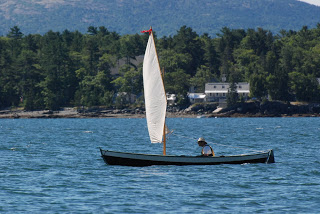
tack on a beam reach for all 8 miles to the stop. It was a hoot to say the least. Drake was right up with all the Caledonia Yawls and other larger sail craft. People were quite surprised to see this long, skinny rowboat pass them or hold position next to boats with much larger sail areas. And to my delight the mast step held.
But this morning was proving something that I try to espouse whenever possible: a rowboat with at least some keel to it can sail downwind quite
fast, but not up wind. And you don't need to ruin
the lines of the boat for rowing and you do not need to add the complexity and drag that a centerboard or daggerboard introduces. Lee boards are simply not necessary for off the wind sailing. Drake has enough stability and keel to even sail without any slippage on a bean reach, and this was a revelation this morning on Frenchman Bay.

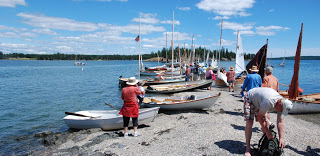
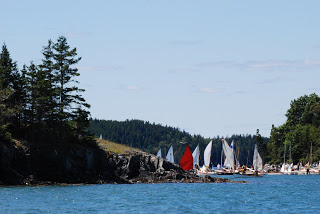
The lunch was quick as the tide was eating up the bar -- we arrived a little too late. But the scene was quite spectacular with MDI and Tunk mountain and islands all around. I was the first boat to the bar and the 50 or 60 boats sailing into the bar was just a blast to watch.

The return trip was a 8-mile row to windward, through Sorrento Harbor right by Hancock Point and dir
ectly to Lamoine State Park. Drake showed her stuff by being able to row a steady 4+ knots back to the start line and beat most of the sailboats that had to tack many times to get home. This is what she was designed to do: sail smartly off the wind and row efficiently upwind. If this were a real RAID I would have no doubt t
hat we could be very competitive and with a larger boat for two rowers, probably win. But I enjoy the autonomy, privacy, and relaxation that rowing and sailing alone can bring.