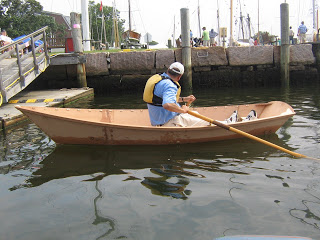
Drake in the Small Reach Regatta on the Coast of Maine: Day 1


The Small Reach Regatta was the next stop in my busy summer. The SRR is a gathering of 70 sail-and-oar boats, this year, at Lamoine State Park and put on by the Downeast Chapter of the Traditional Small Craft Association. Irowed and sailed (downwind) his rowboat design Drake and consistently finished in the front of the fleet (but of course it wasn’t a race!).

This event is an annual gathering and a wonderful chance to test and showcase the boats CCBB sells and builds to designs from around the world, for example Michael Storer in Australia, Francois Vivier in France, Eric Risch in Maine, Bruce Elfstrom's beauties and my own designs. We will be carrying kits and building boats produced by a Finnish builder, Suomen Puuvenepiste. These are unique, semi-exclusive agreements to bring new sailing and rowing boats into the US market as CNC cut kits, bare hulls, and finished boats up to 25 feet. My hope is to bring a demo boat from all these folks to boat shows and events like the SRR. Next year we'll have a Goat Island Skiff Yawl to show off like this one built by a kit customer in TX for the Texas 200:


The event was three days. Day 1 was a short windy upwind row and downwind return to a classic small Maine coast island. Every day features an interesting lunch stop, a wonderful opportunity to rest and to look at others' boats. Moreover, I see it as a learning experience to talk to the builders and owners of the boats. I learn something new from every one of the boats. For me, the SRR is about the finest form of professional development I can get.


On the downwind return to camp, a small squall came through and the force overcame my mast step..."WHAM!"...I heard the snap and the boat lurched and we nearly capsized. The first night was a quick repair with polyurethane glue while the sun set. Day two was to feature a long, fast broad reach to the lunch spot, and there was no way I was going to miss sailing that stretch! I was repairing until I couldn't see anymore boat...will it work?

Teaching at The Wooden Boat School: Tradional & Modern Oar Making

After work at Shaw and Tenney, I had my debut teaching job at Wooden Boat School. One of my favorite (and most labor intensive) specialties is oar making, so I was to teach the traditional way and the modern way, using composite blades. Each students chose an oar type of their choice to fit a boat they had or wanted to have. We had everything from 7' flat blade Spruce oars (for a Nutshell Pram) to laminated plywood spoon blade sculls to a Greenland style kayak paddle.


We were able to get out for two solid rows where CLint coached some fixed seat rowing and we all just enjoyed learning how to use oars and be comfortable in rowboats. We were able to use the school's fleet of rowboats, including this Joel White Shearwater.


Students quickly learned that oar making is mostly a wood removal activity, but they also learned some of my tricks, like adding decorative laminations on the outside of the upper looms. They also learned that there is a bit of engineering and art in making oars. Because we were able to get on the water, we also so the clear link between how we shape oars in the shop and how they react on the water.


Finishing oars after sanding is as much work as shaping them. One of my big pet-peeves is that oars are balanced and we spent a couple hours balancing everybody's oars with a little lead in the handle. It does not make the oar heavier, effectively, because the oar's weight is on the gunwale. Therefore, it is the balance that makes oars feel lightweight. Leathering the oars is a project as well as sealing and varnishing. Everybody left with the oars largely done. One student had a good challenge. He brought in a pair of hollow sculling oars and wanted to make a replacement (or back up) pair in a week. So, we made the loom solid, sized down, and laminated a pair or plywood blades much like I do in my shop for customer's oars, over a laminating jig. The blades are glued on the shaped loom and the finished result looks like this, and I might add he is very happy with them. In fact they are no heavier than the original, hollow sculls!

 
Posted by Picasa


Mast making at Shaw and Tenney

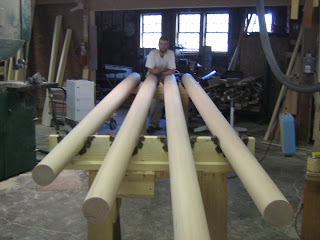
The second iconic work spot of the summer was 2-weeks of mast building at Shaw & Tenney. Shaw and Tenney has been in business since 1858 making gorgeous paddles and oars as well as masts, boat hooks, etc for boats. Sometimes they get interesting orders like for this project building four 8" diameter laminated, Douglas Fir masts for a high-end playground in NYC. They asked me to come up and help them take on this project and I was happy to do it.


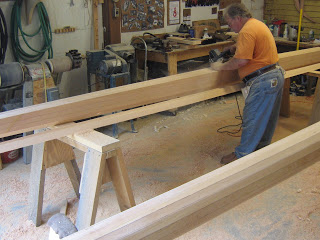
The masts were all cut, rounded, and sanded by hand. They weight a few hundred pounds in the rough and were a challenge to put through the planer. Their dimensions had to be very accurate. Like any mast, once the piece is 4-sided and tapered, we can start 8-siding as we are doing above with a small skilsaw. After 8-siding this way, the mast was brought to 128-siding with nothing but patience and my favorite power planer. After two days plus of the power planer, when I that machine down for good, I can recall my hand vibrating for several hours.


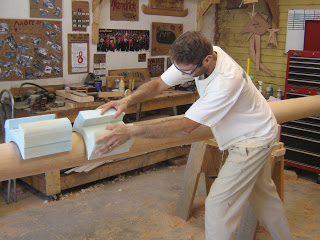
The final rounding was done with custom shaped foam blocks, a trick from boat school that I use on a lot of projects. This was followed by finish sanding with the Festool. The result was some very nice masts! It was a wonderful place to work and watch the masters do their trade. One of the guys has been making oars and paddles for 25 years. To watch him work was quite impressive. I look forward to doing more business with S & T. Recently, they chose Clint Chase Boatbuilder as their official builder of their beautiful Whitehall.


After this project it was back to Portland for an overnight to see the family and pack for the next iconic week: Wooden Boat in Brooklin, Maine. I was to make my teaching debut at the Wooden Boat School.

Wooden Boat Show Family Boat building

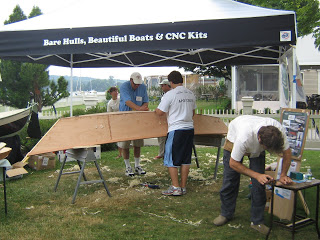
We are catching up with a nons stop summer of boating events and where best to start the series of updates than with the Wooden Boat Show in Mystic, CT. In 2 1/2 days, a father son duo built one of our Echo Bay Dory Skiff kits. They discovered that there is a lot of boatbuilding, sweat, creativity and work to do even starting from a kit.


They launched on the third day at 3pm. They were very proud and perhaps glad they had a break to enjoy their success. My former life was a teacher and instructing people to build their own boats. Getting new folks into small boats, building their own boats from kits, and experiencing success in everyway is the number one priority for our customers. Likewise, we felt this year's Family Boatbuilding was a success and will plan to do these boats again next year.

 
Posted by Picasa