
Early Summer 2015
Early Summer Activities and Updates
Prep, prep, prep!
Mostly my work focuses on watching four Deblois Street Dories getting finished, one of which has hit the water. Compass Project's Dory launched successfully with a a bunch of excited students who helped build her. Compass is looking for another big project commission to use in their work with at-risk youth.
2015 Compass Project launch of the DSD.
I am busily preparing the cutting of more Echo Bay Dory Skiff kits which will be built in Maine. This is the very latest version of the Skiff and any tweaks in the design demand a lot of attention to make sure all the details get done correctly. Those files are done and ready for more customers. It is hard to believe over 30 Echo Bay's have been built now!
Also in the works are the files for cutting the first ever St Lawrence River Skiff kit for the Bain & Co. Annie model. I am back in the computer model after quarter scale modeling the hull.
Quarter Scale Model of the St. Lawrence River Skiff,
Annie
to be built at ABM in an August 10th workshop.
Here is the information for my workshop in August. Spread the word! Contact me for more info.
NEW! St. Lawrence River Skiff Building
Clint Chase, an instructor at the WoodenBoat School, The Landing School, and The Compass Project, will teach how to build a St. Lawrence River Skiff.
This boat is plywood and strip-composite constructed.
One kit will be built in the class and raffled off to one student on Saturday. The boat will have some finish work to still be completed by the raffle winner. Participants must register by July 27 to make sure the class will run.
For more information about the boat visit the webpage about the Skiffs.
Instructor: Clint Chase
Session 1: August 10– 15, 9 AM- 5 PM
Tuition: $1000
Works in Progress
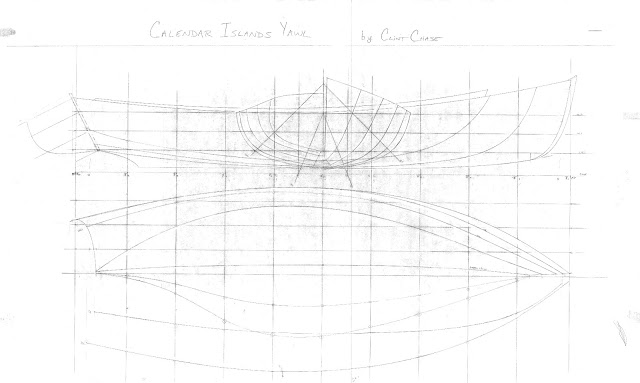
16' Calendar Islands Yawl
project complete
CIY hull #1 on Lake Superior, May 2015.
The lines plan for this lug-yawl have been done for a few years now, drawn as a 19 foot daysailer. A fellow Goat Island Skiff nut and I began talking in 2012-13 about a Maine-waters-friendly version of the GIS, one that can better handle choppy water especially beating to windward and one that is more oriented towards dinghy cruising. I took the CIY lines, scaled it down to 15 1/2' -- the longest boat that can be gotten out of two sheets of scarfed plywood. The hull form has been tweaked to maximize sailing potential without losing the joy of rowing the boat when the wind dies. The CIY 16 will be ideal for daysailing or sail-and-oar boating where sailing will be the primary focus. Yet, with the transom clear of the water, the clean underbody, and the lightweight of the boat, she'll row like a feather and the skeg will allow for good tracking. The 10" wide, reinforced keel-bottom will take repeated beachings for years. This boat is as much about sailing as it is about sailing or rowing to explore the local islands.
CIY hull #1 on Lake Superior, May 2015
Drake 19 Expedition Rowboat
Project complete
Modeled on the very successful Drake 17, the general hull form was stretched and then the hull lines tweaked to favor tandem rowing and camp-cruising. Hull #1 has been built by professional boatbuilder, Walter Baron of Old Wharf Dory Company.
Drake 19 hull #1 in the shop of Old Wharf Dory Co.
See the Drake 19 photo album
Echo Bay Dory Skiff mkIV version
Project complete.
The EBDS launched by students at Boothbay Regional High School in late Spring, 2014. They build from plans and full size patterns and are currently (May 2015) building the second of two from those plans.
When I began my boatbuilding business, the idea of doing kits had not fully formed and I had not fully accpeted or understood the power of computer modeling the boats and cutting kits from these models. I had built over a dozen EBDSs with proven shop patterns that I labored over. No model could rival those shop patterns, or so I thought. I digitized the patterns and never 3D modeled the boat. The kit is great, I love my own boat, but it remains the one boat not modeled in CAD. There are many advantages to doing so, including ease of making modifications, calculating weights and volumes, and visualizing the boat. With years of EBDS experience under our belts, Eric and I will be modeling mkIV and making some changes that include:
- establish a max length of 11'10", the longest one can go with only one scarf per side plank
- Improved skeg and sheer
- calculate flotation and include precut tank or flotation compartments as an option
- optimized thwart locations, mast partner configuration
- fine tune the sailing balance of the boat with both a sprit and lug rig option
- make a set of more detailed construction plans for "scratch" building with a new lug rig option
- make full size patterns that a builder can have printed on paper
- kit version will be quicker and easier to build employing CNC mortise &* tenon joinery
The original EBDS (left) built 26 years ago and the current mkIII kit version.
Fast coastal racing rowboat
Updates here
Mocking up the rowing station in the new boat.
I am in the early stages of conceptualizing a new design for fixed seat rowboat racing in the Essex, Blackburn, and other open water races. The design brief is:
·
~18 LOA, 17 lwl minimum…would look at more if drag is really low
·
Fixed seat rowing, single rowing station, little gear capacity needed
·
Oars must be 8 ½’
·
Oars need to be on gunwale (no outriggers)
·
Undecided RE: pinned, horns, or feathering locks
·
Cartoppable solo and launchable at hand launch sites
·
Speed important want to be able to cruise at 5kts, hold 6 kts for a stretches
·
Able to safely navigate through lobster boat wakes, and wind driven chop on the harbor
·
Tracking is excellent, but need to be able to turn around up river,
·
No tripping over forefoot in following seas
·
Flotation tanks F & A in 4mm ply or places for bags to tie in
·
Double ended or narrow y-shape transom
·
Low WSA and high prismatic, speed important, but not as risk of being unsafe for open water races such as Blackburn
·
Narrow on waterline but some flare for secondary stability, dryness
Cedar-strip construction or 4mm plywood, possible composite tooling
Screenshots of the Drake Raceboat, a narrow, fast 18-footer inspired by the Drake 17 and 19.
8' Gardner Pram
Update May 2015: On the backburner, need to eat and sleep!
This is the same 8' pram that Gardner has in his books. I modeled and cut a kit for a student who needed a tender for his livaboard sloop. I'd like to finish this soon with the feedback from the first boat.
Gardner pram prototype off the CNC cut mold set up.
Daysailers
| The West Coast KDI launched in 2012 |
Update May 2015: The latest KDI is being built on Bainbridge Island, WA by renowned author Lawrence Cheek (May, 2015) and the last launched was in NJ last year. I am hoping to develop a mkII version not that a handful have been built. Ideally, I can take some advance orders to fund the work.
| New Jersey KDI launched in 2014 |
CNC Plywood Kit w/ plans and manual $2,800
KDI Specifications
The KDI was originally designed by Bruce Elfstrom of Lyme, CT, a talented, amateur boat designer who has a penchant for Swedish and Norwegian styled boats. He wanted his popular KDI to be available as a kit so we set to work in 2011. The KDI kit pictured here, hull #3 built in WA, is a huge success. Others are being built in the US and they are available in Australia, France, and the UK. Currently, only kits are available. A plans package may be created in the future that does not require the kit. But I feel the kit is the best for new builders. Explore the links to learn more about the KDI!
| West Coast KDI on display at Port Townshend's Wooden Boat Festival |
Thanks to the East and West Coast "Stevens"
KDI Links
WoodenBoat Forum on East Coast KDI kit buildWoodenBoat Forum on West Coast KDI kit build
Jewell: trailerable cabin classic yawl
Update May 2015: I was involved in the design of this wonderful boat and will continue to offer kits for it even though the other Vivier kits are no longer sold through me.
Study Plans for Jewell $10
Jewell Specs
"In January 2010, I got in touch with Clint Chase, a young boat-builder in the state of Maine, USA. I was looking for somebody able to market boat kits in North America and Clint was looking for designers to develop his boatbuilding and kit business. We had a very fruitful discussion by e-mail and phone and he expressed the need for a new day boat for his family. Jewell was born. A first draft project was drawn in 2010 and the final project was designed in April 2011. As a family friendly day boat, Jewell has to meet the following main requirements:To be trailerable by an ordinary car, and therefore light, and be able to beach temporarily for loading/unloading. To have a large, wide and deep cockpit, comfortable, allowing for fishing and a place where children could be safe.To have a stable hull for family sailing but give excellent performance for raids and weekend sails “with the guys”.To have a cuddy cabin, with a toilet for women and children, a small galley to heat some meals and two berths to spend a night or two on board, or for napping.We also made the choice of a yawl rig, firstly because it is beautiful, and also because Americans are fond of yawls. I was happy to make something different than the gaff sloop I generally prefer on such a day-boat (Stir-Ven, Beniguet, Lilou...). The yawl rig is very versatile, allowing one to sail under main only, or under mizzen and jib. The mizzen also allows the boat to safely point into the wind, tending itself while the skipper starts the motor, puts in a reef, or entertains the kids. In Jewell, the main mast is shorter and lighter, so easier to step. The jib has overlap in order to improve pointing ability. The luff is short in order to have it well tight. It is always a mania for me to design fast boats, especially to windward, as it is also the best for safety. The jib is small and fitted with a roller furling system to avoid the need to come on the fore deck at sea. The mizzen is a leg-of-mutton sprit sail which stow simply rolled around the mast. On a trailerable boat, the centerboard case is generally cumbersome, either in the cockpit and/or in the cabin. On Jewell, the case is almost invisible. The centerboard rotates under the cockpit allowing the skipper or crew (even a 6’6” person) to sleep athwartship on the cockpit floorboard! I usually give to my designs name of rivers (Aber, Elorn, Laita, Aulne...), islands (Ilur, Ebihen, Béniguet, Méaban...) or capes (Pen-Hir, Toulinguet, Beg-Meil...) in Brittany. This time, Jewell is an island, but in the state of Maine, where Clint use to sail, on the other side of the pond!"
| The CNC cut building jig for Jewell |
| Jewell modeled in 3D CAD |
| Trailer is easy with Jewell's hull shape and a customized trailer |
The first kit cut was in France for a German client. The first boat built was actually in Maine. I cut the kit for a commissioned boat built by French and Webb in Belfast Maine. As of this writing the boat is receiving final coats of paint. Here is a building sequence.
| Chris cleaning up epoxy squeeze out along the garboard/bottom seam |
| After turnover, the first task is removing bulkhead supports |
| Boatbuilder Peter Webb and Chris Gardei with owner working out the interior construction |
| Stainless steel rudder-tiller housing. |
| NACA shaped rudder and Torqueedo |
| Reefing comb glued to boom |
| Setting up mast on tabernacle |
| Getting close |
Jewell Links
Jewell on VivierBoats.comPhoto Album of First Jewell built by French & Webb
Other Vivier Boats though CCBB
MORBIC $2,855
ILUR $3,555
BEG-MEIL $3,560
EBIHEN 16 $5,050
Updates and Launches
I'm slowly updating the webpages on the blog. In the meantime, three Deblois Street Dories are slated to launch in the next several weeks, including two in Maine and one by a woman who teaches college Geology in Indiana. The first Drake19 rowboat will launch midsummer. I will do sea trials with Walter Baron, the builder. An Echo Bay or two should launch. And a Caravelle sailing skiff will also launch this season. Lots of activity!
