Deblois St. Dory

A Swampscott Dory, the Ultimate Sail & Oar Boat


The DSD on the Maine Island Trail.

Update May 2015: Three DSD's are being launched this season! One recently sold to a guy in UP Michigan, a balance lug-yawl version with centerboard.


Plans package price (need to build from scratch)
$175 includes Full Size Patterns that you can have printed
(all delivered by PDF downlaod)

CNC Plywood Kit includes all plywood CNC cut and plans package
$2,635
freight add'l, email or call to order

Specifications
LOA 18'8"
Bottom length 13'6"
Beam 4'10"
Depth Amidships 18 3/8"
Hull weight 180-225 lbs (can be built ply or solid)


"Every time that I launch my Deblois St Dory at least one person at the boat ramp comes up to admire and inquire about the boat. While others at the dock are shuttling back and forth in their dinghies or stressfully launching mammoth fiberglass powerboats I can untie, launch, load the dory and be underway in five or ten minutes.  This ease of launch makes the boat very accessible for the times when I just want to go out for a short row after work or for a relaxing sail to watch the sunset."  ~Shane Hall, boatbuilder and owner of hull #1, Portland, Maine

Background


I was compelled to draw the Deblois Street Dory because of a fascination with the dory, its history, and its beautiful lines. Certainly, there were plenty of dories available, one at Mystic I was granted permission to document, but with inspiration from Sam Manning's penned drawings and Gardner's encouraging written words from the Dory Book, I had to draw my own dory.

The DSD hand drawn on paper and in the computer.

I started by drawing a hull shape with the Dion Dory in mind and with Gardner's approach on his dory drawings in mind: to have a shape that was a little more aligned with sailing since this was something people mostly seemed to want. Really what resulted is what a dory truly is, a 50/50 sail and oar boat. The boat was drawn at 1/8th scale, 1/4 scale and modeled in the computer. Two quarter-scale models were built to prove out the lines and proportions.

Quarter scale model of the Deblois Street Dory

Hull #1 was launched in 2010 and is used extensively along the Maine Coast in exactly the sail-and-oar fashion I had in mind. Rowing single or tandem along the Maine Island Trail and beaching at interesting places. Sailing when the wind blows, rowing when it fades. Loaded with kids and gear. Or used for a quick splash after work and before sunset.

First opportunity in early 2011 to try Hull #1!


The DSD is a real Dory

A dory is defined by its construction style as much or more than how it looks. Dory construction is straightforward: cut out a bottom shape, erect 4 or 5 frames, attach stem & transom, and brace this set up upside down over a strongback to establish the rocker. Plank with 4 to 5 strakes, flip, put on gunwales and install seats. And that's really it. My kit goes together just like this: it is a real dory! The kit of course is composed of all the precut plywood needed to build the boat. The frames are precut ply, as well as all planking, and includes patterns for making things like seats. The DSD can be built traditionally as well, pine or cedar planks over oak frames, sawn or laminated.

Hull #1 being planked in Portland, Maine winter 2010.

My dory is updated for recreational use. Flotation is designed into the ends of the boat, the shape lends itself more to initial stability and sailing performance without sacrificing rowing ability, and it is lighter weight. The flotation is essential for safety and self-rescue. I had my kids in mind in wanting a dory that was a little less "tippy" initially. And the light weight makes her much easier to manage on the beach and trailer. In use solo-sailing, the boat benefits from some water ballast under the middle seat.

The mkII version being built in Bar Harbor, Me by a doctor (Spring 2015)


Rowing is a breeze single, double or triple!


One great thing about the DSD is its versatility. This dory rows very easily single with 9' oars, spoons or flat blade. Even in a breeze she tracks well and feels light. Two-up, the boat really shines. With the power of two rowers, speeds of 4kts plus are comfortable. To trim this or any dory, the heavier rower should sit aft. The reason is that in a dory, the lower portion of the "tombstone" transom functionally acts as the skeg, and skegs provide directional stability for a boat.

Believe it or not, the builder/owner of hull #1 often has a third person row. He says the boat absolutely loves it and really flies. He also brings out kids and other adults for a ride. Pack 'em in there, a dory can take a load. From Shane,

"Primarily I use the boat with at least one other person, with two of us rowing we can make great headway straight through a strong wind if we are in a hurry to get to a destination.  In calm conditions the boat is a pleasure to row tandem or with three of us rowing.  The boat is easily manageable solo but flies through the water with multiple rowers."  ~ Shane Hall, hull #1

The Deblois Street Dory loaded up with plenty of freeboard to spare.


Sailing is safe and exciting


If you want to have fun on the water, sail a dory. Dories are not known for superb sailing ability, but by increasing initial stability and moving aft the distribution of volume in the hull, I made this dory fast.

One owner of a traditionally planked, Dion Dory finally approached me at the end of the small boat messabout I host here in Portland. He simply said, "wow, why is your dory so much faster than mine?". I did not tell him that the full sail area wasn't up and the DSD had 2 more people aboard than he did.

Sailing the sprit rig. She is easy to sail when rigged properly and is fast for a dory. Another Dory sail nearby once exclaimed my way: "Why is your dory so much faster than mine!?"


Don't get me wrong, you will need to be on your toes sailing the DSD, especially if you opt for the larger sail area options. Take time to get to know the boat and hone your abilities, reef early, and use some water ballast aboard to help weight the boat down.

There are no fewer than 8 sail rig combinations you can choose from for the DSD: a fishermans sprit rig, spritsails of 76 and 88 sq. ft.; sprit sloop; two lug-yawl rigs, gunter and gunter-sloop. A foil-shaped daggerboard gives the boat good windward ability and is fun to build and easy to maintain.

Take her on the Maine Island Trail!

The DSD at twilight on a MIT trip.

I designed the DSD very much with trail cruising in mind. The Dory seemed the perfect platform for tripping with its versatility, capacity, and flat bottom for beaching.

"Mostly I use the boat for weekend camping trips, island hopping in the bay or cruising around the large lakes of western Maine. Perhaps my favorite characteristic of the boat is the ample room for stowing gear and the fact that the more food, water, books, and supplies that I load into the boat the more seaworthy she becomes.  I have enjoyed weekend trips in Muscongus Bay and Casco Bay exploring several MITA islands.  This versatile, seaworthy boat that can easily be beached and maneuvered through shallow waters. The DSD has opened up a whole new world of coastal inlets and islands to explore."  ~ Shane Hall, hull #1

Maine Island Trail Association has taken interest and the first of a series of newsletter articles has been published. Download it here.

Also click here to see a new story on MITA with the Deblois St Dory and Echo Bay Dory Skiff taking center stage.


Contact Info / FAQ


Contact Info

Clint Chase
92 Granite St #1
Biddeford, Maine 04005
boatkits@gmail.com

What is in a kit? How do they come?

  • CNC Plywood Kits include all the precut plywood needed to build the boat, planking, structural parts, molds (if applicable) & deck. Patterns for solid wood parts may also be included as patterns.
  • The plywood kit comes with a manual (25-50 pages of step-by-step instructions and photos) as well as a plans package specific to the kit (12 or more 11x17 PDF sheets showing the construction).
  • Plywood kits come by freight on 4x8' pallets. The truck comes with a lift gate to lower the pallet just outside your garage.
  • Resources: I am a professional boatbuilder, so I have resources in the form of spreadsheets, lists, and other information that I share with customers, if it is not already in the lists of hardware, supplies, lumber that comes with plans/manual.

What are FSPs?

  • FSP stands for "full size pattern". Some of my boats can be built from full size printouts of all the parts included in the kit. This means you can cut all the parts by hand by laying paper patterns over the plywood and transferring the lines and curves to the wood using an awl or pattern-maker's wheel.

Where are the Vivier boats?


  • Currently, I am only selling my own boat designs as plans and kits. Hewes & Co. is cutting Vivier boats nowadays.

Do you have plans for the kit boats?

  • Some boats are available as plans only and some boats require the kit to build the boat. Under the description of each boat where it says "Status" I indicate whether the model is available as plans only.
  • If it the model is available as "plans only" it means that you can buy the plans package and do not need a kit, lofting, or full size patterns to build.

How do I place an order?

  • Email or call to confirm what you want included and your zip code so I can calculate freight cost.
  • I send a PayPal invoice/Buy Now Button to your email that brings you to payment page. 
  • Pay with your credit/debit card.
  • OR Send a certified bank check (I can offer a 3% discount).
  • OR Send a money order (Post Office is easy) (also a 3% discount).
  • I will confirm receipt once I have payment.

How long does it take to get a kit?

  • Turnaround times can be up to 8 weeks, so please plan ahead!
  • Please be aware that I do teach full time and may not respond or deliver immediately. I go out of my way to be sure people can build my boats. Feel free to follow up by phone or email if you don't hear back in a couple days time.

Call me at 207.602.9587

During business hours I am in the shop all day, so leave a message and I will get back to you in late afternoon or weekend.

I enjoy talking with my builders. So, do not hesitate to call.

Email me at boatkits@gmail.com

Pricing & Links

Pricing

Prices are listed on each boat page in the blog with a buy now button for putting down a deposit. Most folks have questions, so do not hesitate to contact me.

My prices include all the plywood CNC precut as a kit and the plans package which includes the building manual. Plans are available for "scratch building" and include full size patterns. All plans are delivered by PDF.


Links

Linked In Profile


About Clint Chase


Boatbuilder, Designer, Oarmaker, Rower, Sparmaker, Sailor, Teacher...

Professionally, I'm really not sure what I am exactly. My ideal day perhaps best decribes my passion: in the morning I wake up and drink my favorite coffee (either French Press or Pourover method, since you are wondering). After a brisk row I'll get right to my computer and drafting table. I'll open up the latest project, usually a sail or rowboat in the 8-25' range, and begin where I left off, sketching, tweaking, calculating and laying out files for CNC cutting or a new 11x17 layout for a plans package. After lunch, I'll be in the shop building a boat, making oars or spars, or working out construction details on a new boat model. At night, I'm often back at it in the design studio or planning out the latest shop project. These days, I am working a day job, but still design kits on the side. I hope to be back at it full time in 2016.

Clint at The Landing School where he teaches boatbuilding, design, and develops curriculum. Christmas 2013.
Getting on the water is very important to me. Spiritually and physically, it keeps me connected to my body, to my boats, and to the ocean. My specialty is in fixed-seat rowing and I have found that the exercise it delivers is ideal for me, as someone with all sorts of slight hip-knee-back issues. A hard 4-6 mile row is truly a full body workout. And to do it in a highly refined, fast rowboat is a dream.

Rowing Drake in the 2011 Small Reach Regatta.

Rowing and sailing keeps me connected to my boats. In fact, using my boats on the water is an integral part of the design process that I employ to create, make, and refine the finest small boats around. When boats are being put into hard service in all sorts of conditions, things break, issues arise, and design flaws are discovered and fixed right away. (The same goes for the first construction of a model) On the water, a lot goes well, too. But often I find in the first season that the things you expected to be fine (or weren't even aware as a potential problem) are the things that become the issues. And the things you worried about turn out to be no problem! This experiential data -- from my own use or customers' use of the boats -- feeds the design process and tweaks are made to the models. Plans and kits are updated and the next builder benefits. Furthermore, this design spiral brings the boat design towards that elusive point of perfection.

Fixing a broken mast step in the Small Reach Regatta, after a squall blew through the previous day. This is one of those experiences in the Drake Rowboat that helped refine the design of the sail rig and mast. If I hadn't broken my boat, my customers wouldn't have benefited! Look, I'm pretty happy about it, too.

Rowing and sailing keeps me connected to the ocean. For me, that is the major driver: to design and build a boat that nails the design brief,  safely and efficiently carries me to where I want to go, and allows me to enjoy the voyage. My sailing and rowing grounds range the entire Northeast coast but focus on southern Maine. A good day is a quick 4 miles of sailing and rowing after work and the best days are 20+ mile days or rowing and sailing in places like Casco Bay.

A selfie during a 20+ mile rowing trip through Casco Bay. On these voyages I bring the downwind sail rig as auxiliary power. When the wind is fair and above 10 kts I'll fly the "squgsail".
My passions also extend not to just the boats, but the devices that connect boat to wind and water. Oarmaking is about as fine a nautical art form as one can explore. Here is a process of removing a chunk of wood and leaving just enough to create a light, balanced stick with a blade on it to propel the boat. I teach an oarmaking course at The WoodenBoat School called Traditional and Modern Oarmaking. You can learn a lot by reading the course description at the School's website. Oars are the medium that connects oarsman to boat; boat to water. When the oars are just right, rowing is a true joy.

Getting my first rowing race award at the Essex River Race.


Another area of mine is making hollow-birdsmouth spars. I've refined the technique and continue to do so to make the lightest, strongest hollow spars achievable for small boats. The process is fun to go through and the results are beautiful and durable. I've been been consulted with more than a couple well known boat designers looking to broaden their understanding of the hollow-birdsmouth sparmaking techniques and delivered workshops on the subject. It is an ongoing challenge and source of learning for me.

Applying the evil eye while sighting a 25' mast being glued up in a jig.


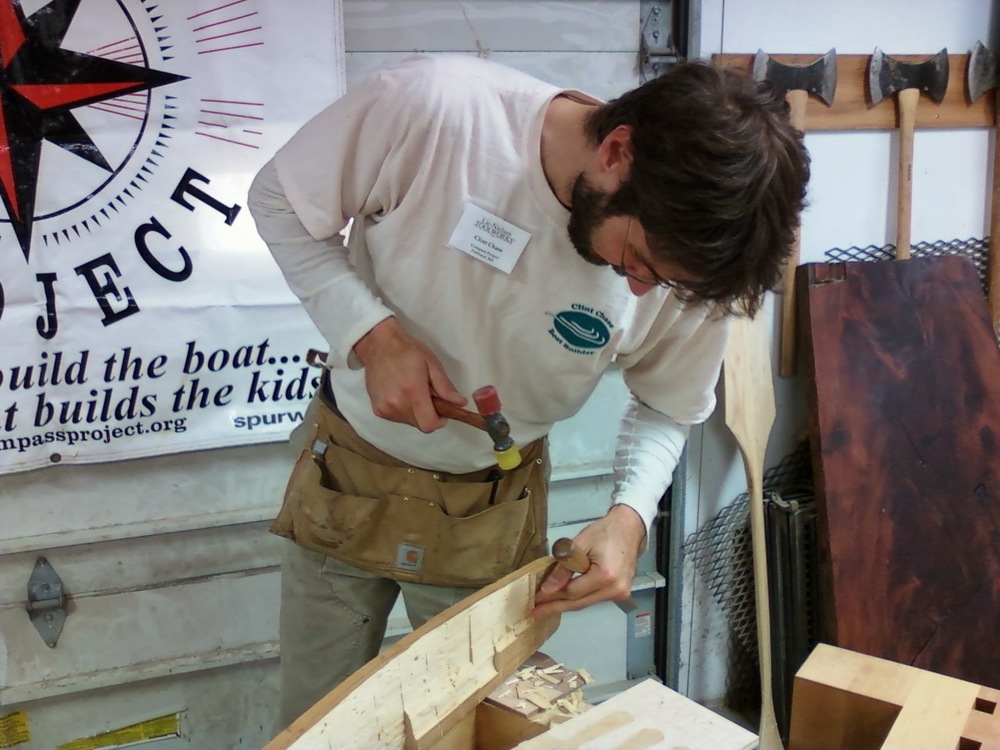
Teaching is an important outlet for me. I love to teach people to love the craft as much as I do. To see a student begin to understand how a tool works, or get their head around a process, or see why something works the way it does through direct experience is rewarding work. I teach regularly at The WoodenBoat School -- two classes in strip-composite construction and another in oarmaking. My work at The Landing School however is year round and full time. I've taught boatbuilding for several years at The Compass Project in Portland, Maine. And I've given workshops at boat shows a other boat shops. In all these settings, I find great reward in seeing students grapple with the skills, patience, and persistence it takes to craft boats, oars, spars, and new designs.


Giving demonstrations at the annual Lie-Nielsen Tools open house at their headquarters in Warren, Maine.


In summary, my passion truly lies in the complete design spiral: seeing a mental image of a new boat come to life on paper, go through the CAD process on the computer, leave the computer as prints, quarter scale models, and eventually as CNC cutting files. The parts get cut, assembled, finished and sea trials commence. We're only 3/4's of the way through the loop. It takes times to make all the decisions that lead to a revised boat model and a new start to another design loop. It really never ends, and therein lies the beauty of boatbuilding, design, and getting on the water: there is always something new to learn.

The best teaching of all is helping my kids learn to love boats and the water like I do....

Jia learning to row at 5...Dad has her...see that rope to the right!

Oliver, 8, taking his Dad out for a sail!

St. Lawrence River Skiffs

An Historical Skiff

The St. Lawrence River Skiff (SLRS) is a 

guide's boat indigenous 

to the Thousand Islands Region of NY, emerging on both sides of the river around Clayton and Alexandria Bay, NY in the late 1800s. Its hull form evolved and became the standard river boat of its time. Guides had to row, all day, paying clients who wanted to productively fish the River. A guide might row 20-30 miles in a single day! The boats had to be stable, easy to row, and able to take all the conditions thrown at it in a day on the river. They were

A guide with clients circa 1900 glass plate. Photo from 

ThousandIslandsLife.com

A typical St. Lawrence River Skiff at the boathouse/livery. Photo from 

ThousandIslandsLife.com

Today, families still row their Skiffs on the River for pleasure, picnics, and fitness. The easy-pulling nature of the Skiff even at maximum 

capacity

 makes them perfect for bringing the family out on a cruise or to an island picnic. The flat, plank keel make them easy to beach and sit up right at the boat house. 

Tad Clarke and family of Comfort Island still row their original

Bobby

built in Alex Bay by Hunt sometime before 1905.

Some Skiffs could be sailed and some of the boats specifically carried a centerboard, but the

Bobby

does not have a centerboard and shouldn't. Bobby will 

excel at sailing downwind much like the

Drake

Rowboat. The other models could also sail downwind with a small lug or spritsail. Resist the urge to use a leeboard or centerboard. These add slot drag and complication. Row upwind; sail down.

The Antique Boat Museum in Clayton houses a fleet of Skiffs and holds the plans for a half dozen Skiffs, several of which were drawn by fixed-seat rowing guru, Andrew Steever. The ABM exhibit documents the emergence of the craft and evolution from utility to pleasure boat to racing boat.

The SLRS collection at Antique Boat Museum in Clayton, NY. Photo ABM.

Some SLRS models were developed to race and were raced by expert helmsman. They were sailed rudderless, steered by shifting weight fore and aft to tack the boat. Photo ABM.

Modeling the Hulls

I collaborated with small craft guru and engineer David Cockey to model the hulls. We took the Steever plans from ABM input the offests into Rhino, a 3D CAD program. The hull surface is modeled to a high degree of fairness and accuracy. One of the intricacies of the Skiffs we "fussed" with is the hollow in the garboards in way of the keel and the notable hollow in the waterlines fore and aft. The Skiffs all feature a slightly finer waterline in the stern than in the bow. It is believed that this is feature that came from the Birch Bark Canoes which may have strongly influenced the Skiff form. At speed, a finer hull aft trims the boat down at the stern and helps the boat track straighter.

Then the hull is sliced and diced into horizontal and vertical slices called waterlines, buttocks, and station sections. The station sections become the shapes that are used to cut the molds. The shapes are flattened onto a 2D plane and then "dropped" into a 4x8' recatangle representing the sheet of 3/4" MDF or plywood. At the CNC machine shop, the operator programs the machine to cut to the geometry I give them in the form of a nesting file. Their cut file gives the machine the x-, y-, and z- coordinates for every point along the curve. The result is a mold cut to within 0.003" (three thousandths of an inch!) tolerance. These cut files are the keys for the mold kits to each Skiffs.

The

Annie

modeled in Rhino 3D. Photo C. Chase.

An example of a nesting file 

Frye

Skiff) used by CNC machinist to cut a kit. Photo C. Chase

The Skiff kits were cut at Hewes & Co. in Blue Hill and built at WoodenBoat School by my students in the Strip-Composite course that I teach. Over a single week, students set up the molds, strip planked the hull, and sheathed the hull in fiberglass. The kits are available for those who want to make their own strip-built boat. I hope to have plywood lapstrake kits also available.

The

Frye

Skiff being stripped. Photo C. Chase.

The

Bobby

at the end of a class. Photo C. Chase.

The Skiff Kits

Currently, lapstrake plywood kits are not available. These kits are specialized for strip-composite construction. But a builder can use the molds, avoid the lofting, and line off their hull for lapstrake planking.

Bobby

is the longest of the bunch and symmetrical fore and aft. For tandem rowing and camping along the Maine Island Trail, for example, this model would be the best because of the capacity (Bobby can safely carry up to 720 lbs) it has and waterline length it features. Yet, the boat is light enough and easy gliding for one rower. She is the one I kept for my fleet.

Annie

was built many times by Keith Quarrier in Alstead, NH. Keith ran for awhile, building a number of Annies. He grew up visiting the Thousand Islands Region and has built and fixed up many SLRS's. The Annie pictured is one of his own. Annie is stable and fast, having one the Blackburn Challenge and finished in the top places against Adirondack Guideboat rowers. Annie can safely take two other adults aboard with a maximum capacity of about 425 lbs.

The 

Frye

Skiff is the smallest and is offered as the ultralight, cartopper of the bunch. She is ideal as far as offering good performance in a shorter boat...any longer and cartopping is tough; any shorter and you really lose the glide in your rowing stroke. The Frye can safely carry another adult with a maximum capacity of about 325 lbs. She features a beautiful shape in the stern that will provide absolute pleasure when rowing.

The Bobby-Lynn (a.k.a 'Bobby')

The original 

Bobby 

on 

Comfort Island

 on the St. Lawrence R. Photo courtesy of Tad Clarke.

Bobby-Lynn Kit (CNC cut molds) $895

freight not included.

Bobby-Lynn Specs

LOA 20' 5"

Beam (max) 42"

Waterline length 19' 2" 

Waterline beam 33 1/2"

Draft (dwl) 4 1/2"

Depth amidships 13 7/8"

Dry hull weight 125lbs

Christmas 2013: Clint purchases boat from WoodenBoat School to finish for himself and two kids. Currently at The Landing School being finished for launching in 2014 before snow flies again. Photo CBChase

__________________________________

The Annie

Photo courtesy of Keith Quarrier, Quarrier Boats, Alstead, NH

Annie Kit (CNC cut molds) $825

freight not included.

Annie Specs

LOA 17' 6"

Beam (max) 39"

Waterline length 15'8"

Waterline beam 32"

Draft 4" at dwl

Depth amidships 13"

Dry hull weight 100lbs

___________________________________

The Megan (a.k.a. the Fry Skiff)

The 1st Fry built at WoodenBoat School. Photo C. Chase.

Kit for Megan (CNC cut molds) $750

freight not included.

Frye Specs

LOA 15'3"

Beam (max) 39"

Waterline length 13'4"

Waterline beam 27"

Draft 3 3/4" max

Depth amidships 13"

Dry hull weight 75 lbs

__________________________________

Learn More

St. Lawrence River Skiff goes beyond

, Thousand Islands.com

About the Skiff

, Thousand Islands.com

Native to the Thousand Islands

by Andrew Steever in WoodenBoat back issues:

Part 1 #20 Jan/Feb, 1978 pp 48-51

Part 2 #21 Mar/Apr, 1978 pp 26-29

Ordering Plans & Kits

Email me with your zip code and whether you are residential or business (indicate loading dock or not) so I can give you a kit quote with freight included. The Skiff kits to date are specifically for strip-composite hull. The kit is all the molds CNC cut. Strips, fiberglass, solid wood, and epoxy would need to be bought separately, but I can furnish lists to make this easy. The plans need to be ordered separately from Antique Boat Museum. A molds set up plan is included with my kit.