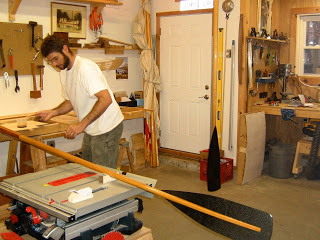
Oars are a delight to make and we are trying to make something new for the market. A prototype for a Carbon Fiber blade-Spruce oar has been completed for a customer here in Portland to be use for his new sculling boat, an Annapolis Wherry, being built by him from a Chesapeake Light Craft kit.

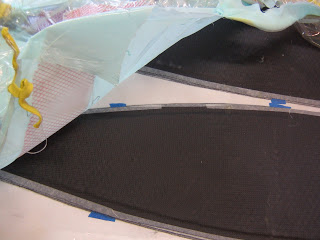
The main prototype effort here were the blades, an infused laminate of carbon fiber with a light core material in the middle.

The core adds stiffness with negligible additional weight. Infusion is incredibly tricky to get right and much time was spent in making it work to make a perfect blade.

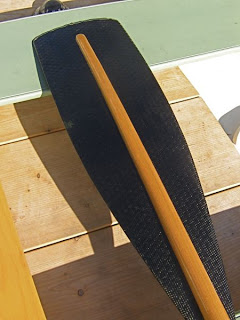
The looms are Sitka Spruce for these oars (and can be done in native Northern White Spruce) and they are specially designed such that they counterbalance perfectly with the carbon blades. The blades will lay on the top of the water and without any pressure from the hands.
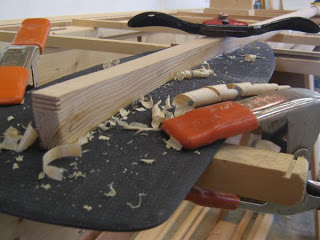
This balance means less fatigue for the rower, a better feel, and greater speed because the rowers kinetic energy is not wasted in moving a blade-heavy oar forward and backwards as the blade exits at the release and enters at the catch. Another design element to Clint's oars is in their flexibility. Oars should flex a little, especially in fixed seat boat, but also in sliding seat boats (the amount will differ depending on the rower). The faster the boat goes and the faster the rower wants to go, the stiffer they may want their oar to be made. But for recreational sculling and pleasure rowing in fixed seat boats, you want an oar with an amount of flexibility. It means less fatigue, a gentler stroke at the beginning and end, and better endurance for the rower. How much flex is very subjective and based on experience on the water as well as intuition. When Clint makes oars, you'll often see him shaping the loom then taking it to the floor and springing it. Then the shaping continues based on the feedback from the wood.
Every board, each species, and different length oars will all feel different. What is 'right' is based on our customers' needs, rowing style, their goals, the waters and conditions the rower is in most of the time, and of course it depends on the boat itself.
You'll notice that the oar blades are quite different between these two oars.

The blade area and the shape are key factors in how much "
Slip" the oar has in the water. Slip is a term for how much 'grab' the blade has on the water, how much water the blade holds. Thus, a large, wide blade slips less in the water and can
potentially produce more drive for the boat. There are other factors of course. But for the sake of this post, looking at these two different oars, the spruce spoon blade oars are specifically made for open water conditions where feathering is not completely necessary. The carbon blades will need to be feathered especially when the water is choppy. The blade area is also more outboard making these more efficient oars for flat water conditions or when there is a slight chop, for feathering. Other differences between these oars are in the oar 'leathers'.
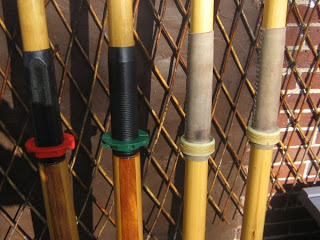
The carbon blade oars have a plastic sleeve that makes feathering easy. The all spruce oars have traditionally stitched leathers with a custom 'button' that we produce on a lathe with nylon.
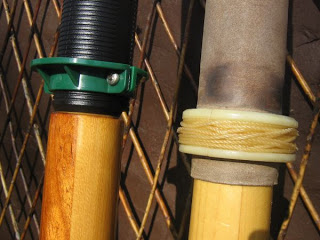
The split buttons are seized to the leathers with nylon twine and epoxy (and elbow grease). Another big difference between these oars are the upper looms. We laminated spanish cedar to the upper looms of the carbon blade oars to help counterweight the oars and make the looms a little more durable (and it looks snazzy!). The result is very nice and no lead counterweights were needed in the handle. The oars are sensationally light for 9'6" sculls.
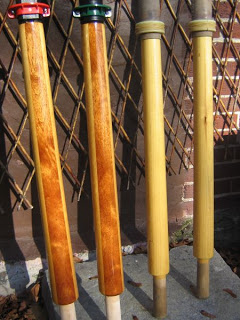
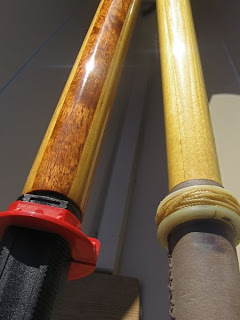
I will update the post when I have a proper scale to take weights. The spruce spoons are counterweighted with 2lbs of lead (see lead insert sticking out of handle, boring hole for other insert).

The balance point for both oars is just below the leathers and the result is a very comfortable oar on the water that is effortless to bring through the stroke cycle, from recovery to catch, the blades have little perceptible weight to them. Careful varnishing follows construction. We use a fabulous product called Le Tonkinois, a linseed varnish that makes a durable finish that is very easy and pleasurable to maintain.
A parting shot shows what makes me as excited about this new kind of oar as much as the performance benefits it is the aesthetics that make them special. The contrast of Spruce wood and Carbon Fiber to me represents the yin and yang of oarmaking -- balance. We are trying to make rowing more fun with balanced, high-quality, beautiful oars made with passion.