Oars and Oarmaking: Different Strokes for Different Folks


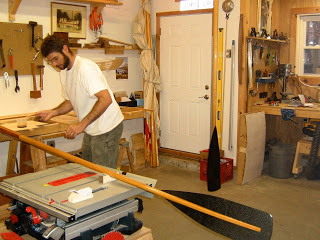
Oars are a delight to make and we are trying to make something new for the market. A prototype for a Carbon Fiber blade-Spruce oar has been completed for a customer here in Portland to be use for his new sculling boat, an Annapolis Wherry, being built by him from a Chesapeake Light Craft kit.

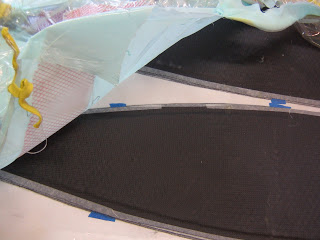
The main prototype effort here were the blades, an infused laminate of carbon fiber with a light core material in the middle.


The core adds stiffness with negligible additional weight. Infusion is incredibly tricky to get right and much time was spent in making it work to make a perfect blade.

The looms are Sitka Spruce for these oars (and can be done in native Northern White Spruce) and they are specially designed such that they counterbalance perfectly with the carbon blades. The blades will lay on the top of the water and without any pressure from the hands.

This balance means less fatigue for the rower, a better feel, and greater speed because the rowers kinetic energy is not wasted in moving a blade-heavy oar forward and backwards as the blade exits at the release and enters at the catch. Another design element to Clint's oars is in their flexibility. Oars should flex a little, especially in fixed seat boat, but also in sliding seat boats (the amount will differ depending on the rower). The faster the boat goes and the faster the rower wants to go, the stiffer they may want their oar to be made. But for recreational sculling and pleasure rowing in fixed seat boats, you want an oar with an amount of flexibility. It means less fatigue, a gentler stroke at the beginning and end, and better endurance for the rower. How much flex is very subjective and based on experience on the water as well as intuition. When Clint makes oars, you'll often see him shaping the loom then taking it to the floor and springing it. Then the shaping continues based on the feedback from the wood.
Every board, each species, and different length oars will all feel different. What is 'right' is based on our customers' needs, rowing style, their goals, the waters and conditions the rower is in most of the time, and of course it depends on the boat itself.

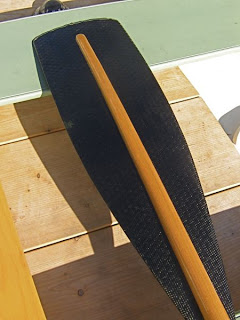
You'll notice that the oar blades are quite different between these two oars.

The blade area and the shape are key factors in how much "Slip" the oar has in the water. Slip is a term for how much 'grab' the blade has on the water, how much water the blade holds. Thus, a large, wide blade slips less in the water and can potentially produce more drive for the boat. There are other factors of course. But for the sake of this post, looking at these two different oars, the spruce spoon blade oars are specifically made for open water conditions where feathering is not completely necessary. The carbon blades will need to be feathered especially when the water is choppy. The blade area is also more outboard making these more efficient oars for flat water conditions or when there is a slight chop, for feathering. Other differences between these oars are in the oar 'leathers'.
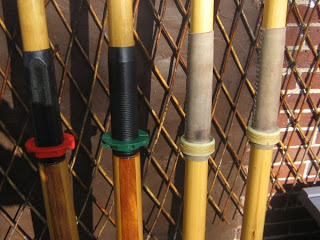

The carbon blade oars have a plastic sleeve that makes feathering easy. The all spruce oars have traditionally stitched leathers with a custom 'button' that we produce on a lathe with nylon.
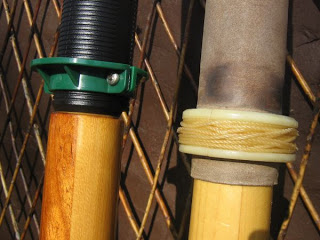

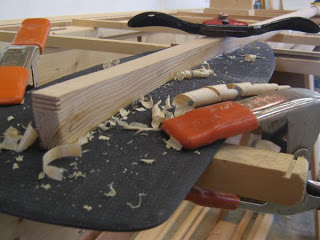
The split buttons are seized to the leathers with nylon twine and epoxy (and elbow grease). Another big difference between these oars are the upper looms. We laminated spanish cedar to the upper looms of the carbon blade oars to help counterweight the oars and make the looms a little more durable (and it looks snazzy!). The result is very nice and no lead counterweights were needed in the handle. The oars are sensationally light for 9'6" sculls.
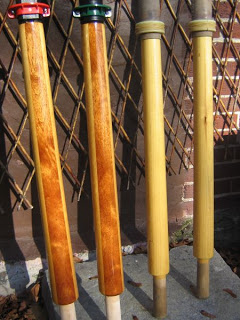
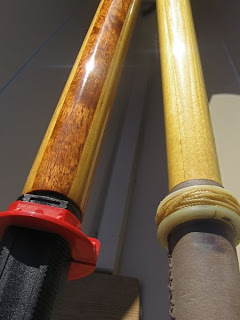

I will update the post when I have a proper scale to take weights. The spruce spoons are counterweighted with 2lbs of lead (see lead insert sticking out of handle, boring hole for other insert).

The balance point for both oars is just below the leathers and the result is a very comfortable oar on the water that is effortless to bring through the stroke cycle, from recovery to catch, the blades have little perceptible weight to them. Careful varnishing follows construction. We use a fabulous product called Le Tonkinois, a linseed varnish that makes a durable finish that is very easy and pleasurable to maintain.

A parting shot shows what makes me as excited about this new kind of oar as much as the performance benefits it is the aesthetics that make them special. The contrast of Spruce wood and Carbon Fiber to me represents the yin and yang of oarmaking -- balance. We are trying to make rowing more fun with balanced, high-quality, beautiful oars made with passion.

Good News

Clint's design the Drake Rowboat, "A new take on the Faering for the modern oarsman" is featured in the 2010 Small Boats edition by Wooden Boat Publications. It is on newstands and it is a great issue. Click here for more info.

Clint is also a recommended US builder for Michael Storer boat designer and will be producing a line of high-performance rudders and centerboards using a unique foil template developed for small boats by Michael Storer with research done by Aerodynamicist Neil Pollock. In addition to high performance foils, look for tillers, Birdsmouth masts and spars, and a new oar designed by Clint employing carbon fiber blades on a refined Sitka Spruce loom. This new oar will be up in a few days, so stay tuned! You can see more about Michael Storer's talk at my shop earlier in this blog site. Michael's website is http://www.storerboatplans.com/

Fall Row


Today was a short 9 mile row around some inner islands of Casco Bay. Pushed hard and maintained a little under 5 kts much of the time. One of the few times I've really pulled much of a wake in Drake. One thing to look for in any great rowboat is the wake. The clean exit of water such that it is not attached to the boat, but rather breaks cleanly from the surface of the boat as the hull passes by means less drag. When power is applied to a boat's hull, the stern is depressed as the hull approaches hull speed and tries to climb the bow wave created by the hull itself. The result of this is drag from the transom, if the boat has one. Others have commented about the lack of any visible wake left as we row by in Drake. The trade off of this low drag means that it is tough to hit top speeds...getting into the 5-6 knot range is something I have not done with Drake for any stretch, but have also not spent much time trying to do. This row I took, leaving the kids behind with Mom on the beach, saw a variety of conditions that reminded me how proud I am of designing Drake. Whether it was headwind, tailwind, a cross-breeze, a chop on top of open ocean swell, or bucking a strong flood tidal current, we were still able to maintain 4.5 + knots for about 2 hours. My wife, who was a top collegiate sculler, commented as I rowed back onto the beach, "Holy cow, that was quick! How'd you do that so fast."

Michael Storer Talk and Messabout at Clint Chase Boatbuilder

Dana, Clint, and Michael getting things started...

Clint introducing the speaker and asking everyone to share a bit about themselves...

Lots of visuals during the talk...

Including an amateur built rudder and rudder box for a Goat Island Skiff.


On November 1st I was pleased and honored to introduce Michael Storer, an Australian Boat Designer reputed for his simple, elegant, and approachable boats, to a group of 21 members from the wooden boat community in Maine, Massachusetts, and New Hampshire. Some knew of Storer's work, others have built his boats, and many knew him as an important name and wanted to learn more about the man and his message. His message was simple: that we can vastly improve our boats by paying a great deal more attention to three areas: the centerboard and rudder foils, the spars and sail, and the hull itself. With regards to the foils, Michael convinced is audience that it is the way they are made -- with care towards fair, accurate foil shape and towards a smooth surface -- that most matters. Michael has taken research in optimal foil design and applied these foils to boats that, without them, would not sail nearly as well upwind and would be much trickier to handle. These foils are flat in the middle, thin for reducing weight and wood use, and closely approximate the hydrodynamics of a true NACA shape, without the expense and fuss and awkwardness of a wing-shaped foil in a square centerboard box or rocking around on a flat work bench during shaping.

With regards to spars and sails, Michael's point was clear that the most important aspect of spars is that they flex and bend in the right way, the right amount. Spar bend is critical to the ability of a sail rig to absorb a gust, reducing heeling and putting the energy into forward momentum. The sail need not be a 600-dollar racing sail, but a simple polytarp will do cut with round to create the draft necessary to create power in the sail. His PDR Oz boats are a case in point. They all sail with polytarp sails, about a $30 dollar investment. And because they all use the same cloth, they can race against each other without the "upping the ante" attitude that has cause racing to be more expensive and less accessible to more and more people around the world.

Interestingly, Michael left the hull out for last. He says the hull is less important because of the way quality foils and spars can make a good boat go faster than it should. The PD racer is a square hull and wide flat bottom. As evidenced by the messabout after the talk, it does go beautifully. Why? Because of the foils and spars, but also because the hull is light. Michael discussed the keys to making a hull light, using light plywood in a hull that is reinforced the right way, using stringers, fillets, butt joints, and interior compartments that create a light, stiff structure with nothing more than 6mm plywood. Fiberglass is heavy and Michael stressed that fiberglassing adds weight with little gain in structural integrity or even abrasion resistance. Most boats being glassed with 6oz cloth do not need it for structure and are not being used in such a way they it is needed to protect the boat from abrasion. Cloth as light as 2-oz cloth will be enough. He said that builders have also succumbed to the "upping the ante" mentality, trying to do things better and better and better than anyone else, ending up with heavier boats and poorer performance.

Australia saw another 25-plus years of wooden boat development that America and Europe did not see because of the way that market forces drove us to Fiberglass boats much sooner than they did in Oz. The result is much further refinement of glued-plywood construction and testing in the small boat racing circuits around the country. We are just now learning here in the States, thanks to Michael's generous knowledge sharing and this trip he has made to the USA.

Afterwards we enjoyed some great rowing and sailing off Portland's East End. Pictures of the messabout can be seen at the WoodenBoat Forum and at Michael Storer's own Oz Forum:

http://www.woodenboat.com/forum/showthread.php?p=2372819#post2372819
http://www.woodworkforums.com/f169/

Folks will see many of Michael's philosophies played out at Clint Chase Boatbuilder in the Spruce-Composite oars, Birdsmouth masts, and soon foils, tillers, and other components made to improve the performance of customers' existing dories, skiffs, dinghies, and utility boats. Please check my website as updates will be ongoing as product development progresses and made available for sale.