VIP R & D on CF Oar Blades


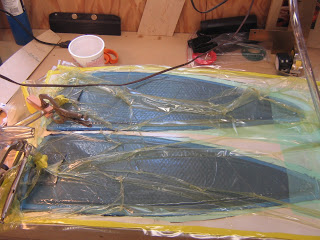
Vacuum Infusion Process (VIP) is the name of the technique used to make composites. In Maine, this is the new generation of composites and much of our advancement in the state is owed to the North Star Alliance which administers Federal funding Maine received a few years ago and to the Maine Advanced Technology Center which trains people in VIP using world experts in the technology. VIP is easy in concept, difficult in practice: the reinforcements for the part (carbon, kevlar, fiberglass, core materials). Our oar blades are a couple layers of Carbon Fiber on either side of a core called, Soric. The core adds stiffness without much weight; the carbon gives the strength. HOW the carbon is sized, the weave pattern, the fiber orientation all impact the properties of the oar. This will take time to develop, but we believe it is worthwhile. Part of the difficulty is that so few are taking on VIP in small shops to produce part. WE ARE PAVING OUR OWN WAY!

These pictures show some of the behind-the-scenes of the process. The carbon fiber is a woven fabric like any that cuts with scissors. We cut it to a pattern a little oversize. The carbon has a stiffness to it that harks to it's eventual properties when infused with resin. Yet, it drapes like any fabric might. The shop is getting a little cool now so, to keep mold temperatures and ambient curing temperatures up, we create a warm environment with good-ol' lamps. There will be plenty more to show after the next set of blades is complete this week.
Update on Projects


It has been awhile so this is a quick overall update on projects:

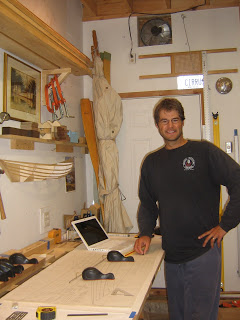
* Goat Island Skiff kits can be cut anytime. Marketing for kits will begin by late Winter time and CNC cutting will be part of the plan. Meetings with CNC companies will happen early winter. I am taking coursework in Rhino/CAD to enable me to create files, modify files, and give them to CNC cutters.

* The Deblois Street Dory lines and offsets are finished an available. Hull #1 is being built by a customer here in Portland. Construction and sail plans are being produced now and plans will be available this winter. Kits for the D St. D will eventually be produced for the kit catalog.

*Frolic, the Flying Fifteen is as it was upon delivery. The keel comes off in the next week. As this is a personal side project, progress on it depends on how much customer work is going on at the time. Clearly, we have been busy with customers, so Frolic sits awaiting her complete restoration.

*Carbon fiber blade-Spruce oars are underway and will be part of a line of custom and semi-custom oar and paddle offerings that will become part of our specialty line of products. An online shop will be part of this endeavor, but probably won't be set up until early Spring in time for the Boat Shows. The blades are epoxy, vacuum-infused carbon fiber for total lightweight blades and balanced oars.

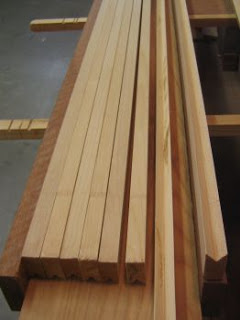
* Another specialty is Birdsmouth mast and spar construction for craft up to 22'. In the shop, staves are being cut for a Shellback Dinghy and Goat Island Skiffs. We use beautiful White Spruce and Sitka Spruce. We'll be combining the two species to make beautiful masts. Clint will have a line of mast types to choose from revolving around Birdsmouth construction, with different wood species to choose from for the spars.

Welcome home Frolic!

Flying Fifteen #87
Built in England 1950
Hot Molded Mahogany Hull
Spruce Spars


A new restoration project has come into Clint Chase Boatbuilder, a personal project of the owner/proprietor and co-owned with Vlado Dresar, a family member and fellow craftsman who lives in Ontario. Although the project is part of the projects at Clint Chase Boatbuilder, she deserves a separate blog. Feel free to follow along at a new blog, The Restoration of Frolic.

A lot of activity at the boat shop!


Carbon oars are in style at Clint Chase Boatbuilder! These are a pair made by Clint's students. They can made at any size, shape, and part of any length oar. They make most sense on 8' or longer oars where outboard weight must be kept to a minimum.

On the Dory design front, the lines are complete. To learn about my design approach, click here.

Other news: coming into the shop will be a vintage Flying Fifteen the building of which was supervised by Uffa Fox himself in the ate 1940s. Photographs will be forthcoming. The plan is to give the boat a total restoration. Everything is orginal: oak spars, Egyptian cotton sails, laminated mahagany hull (varnished).

Quite a few inquiries into Shellback Dinghies have been coming in with one order in place. If interested in this great boat, please let us know!

Slow Beginnings


Since starting to work in my shop "full time", I have yet to put a full day in due to a neck injury and complicated planning to adopt a girl from China. Nevertheless, some light duty work is getting done, namely the modeling of the Deblois Street Dory for a customer, some marketing work (such as starting the blog!), and some prep work for some spar and oar making. We ordered several hundred dollars worth of carbon fiber and other supplies for making the carbon blades with the Vacuum Infusion Process (VIP). More on that later when we get started with infusing the blades.

For now, check out the dory model lines which have been finalized on the model and will be transferred to the plans tomorrow for the customer. Each batten that you see represents the overlap of the planks, the "lap" width, roughly 1". So the lower edge of each batten, made out of 1/4" x 1/8" pine strips, represents the bottom of the plank. They were hot glued on by eye and adjusted until it looked "right". The next step, after drawing these lines on the paper plans, is to draw the construction and sail plans. The customer will be building this Fall.